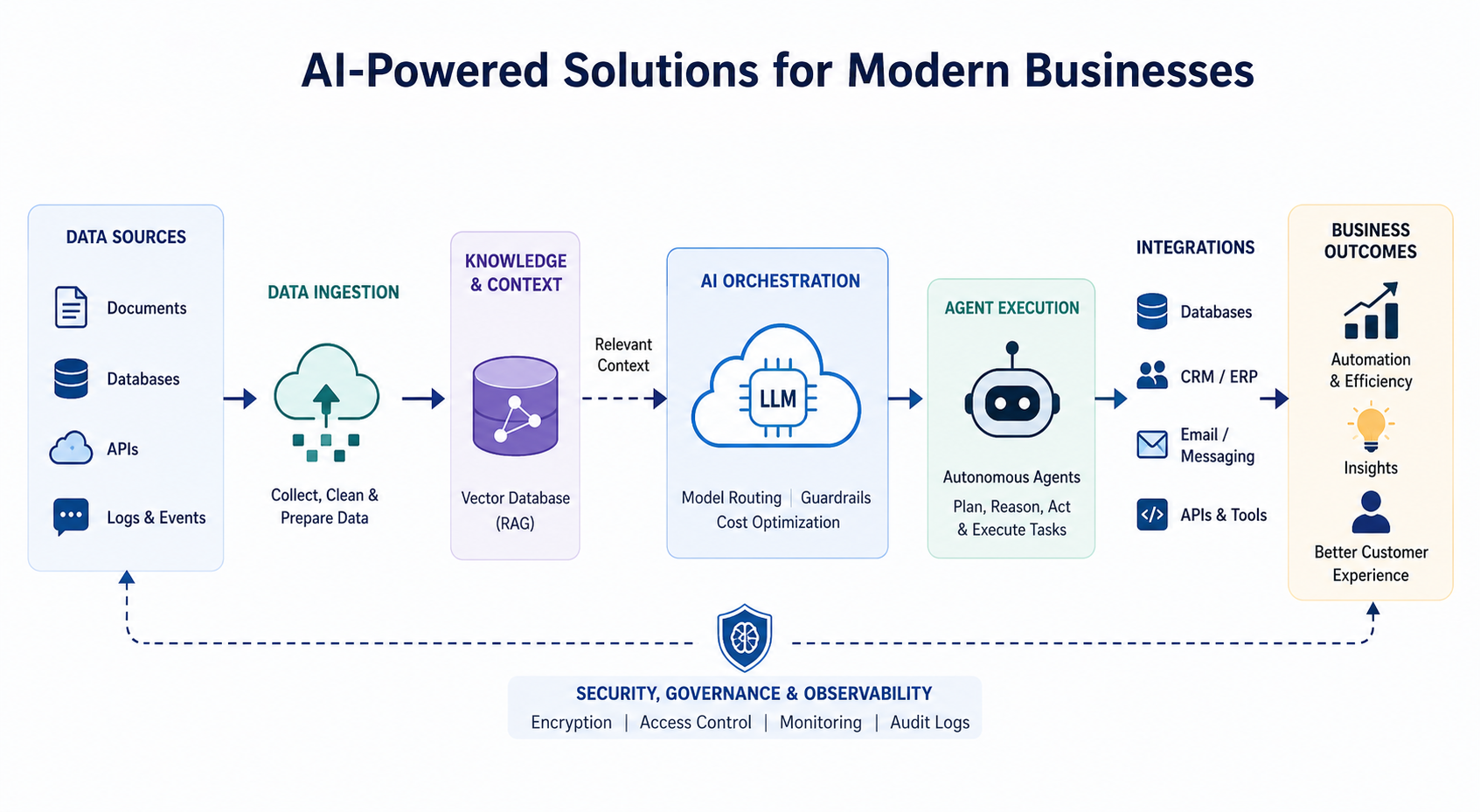
Beyond the Hype: Building AI-Powered Solutions for Modern Businesses
By Badri Tamang | Published: May 2026
Fifteen years ago, integrating new technology into business systems was a predictable engineering process. Whether deploying local infrastructure, database clusters, or early cloud migrations, systems followed strict deterministic logic: defined inputs always produced expected outputs.
In 2026, that predictability has changed. Artificial Intelligence is no longer a supporting tool—it is becoming the core execution layer of enterprise systems. We now design Agentic AI workflows capable of reasoning, planning, and executing multi-step business operations autonomously.
However, many organizations still struggle with production-grade AI adoption. Unstable outputs, rising cloud costs, and hidden security risks often emerge when AI is treated as a plug-and-play solution rather than a system architecture problem.
The real challenge in enterprise AI is not model capability—it is system reliability, control, and security.
Building production-ready AI systems requires shifting from prompt engineering to full-stack AI architecture design. Let’s break down the core engineering principles behind scalable AI solutions.
1. Architectural Pillars of Enterprise AI
Enterprise AI systems must be built on three foundations: contextual accuracy, operational guardrails, and cost efficiency.
A. Context Isolation via Retrieval-Augmented Generation (RAG)
Instead of fine-tuning large models on enterprise data, modern systems use Retrieval-Augmented Generation (RAG). This approach keeps models stateless while dynamically injecting relevant, up-to-date context from vector databases such as Pinecone, pgvector, or AWS OpenSearch.
This ensures responses remain grounded in real enterprise data rather than outdated or hallucinated model memory.
B. Decoupled and Asynchronous Processing
Production AI systems must avoid tightly coupling inference workloads with user-facing applications. Instead, event-driven architectures using queues like AWS SQS or Kafka allow AI tasks to run asynchronously, improving scalability and system resilience.
C. Cost-Aware Model Routing
Not every task requires a large language model. Production systems should intelligently route requests to smaller models for simple tasks while reserving high-capability models for complex reasoning and decision-making.
2. Hardening the Production AI Pipeline
Securing AI systems introduces new risks beyond traditional application security. Prompt injection, data poisoning, and agent manipulation are emerging threats that require architectural-level defenses.
Just as SQL injection once shaped web security, prompt injection is now redefining AI security boundaries.
3. Security and Access Control for AI Systems
Autonomous AI agents must operate under strict least-privilege principles. They should never have unrestricted access to databases, APIs, or internal systems.
Instead, AI components should run in isolated environments such as containers or sandboxed services, with tightly scoped API permissions and full audit logging enabled for traceability.
Encryption must also remain a baseline requirement, protecting both data in transit and at rest using modern cryptographic standards.
The Path Forward for IT Leaders
AI is rapidly becoming the foundation of enterprise automation. However, success depends not on model selection, but on system design discipline.
Organizations that treat AI as an architectural system—rather than a standalone tool—will achieve scalable, secure, and cost-efficient intelligence at production scale.
The future belongs to systems that are not only intelligent, but also controlled, observable, and secure by design.





3 Comments
Daniel Brooks
Strong explanation of RAG architecture. The distinction between fine-tuning and retrieval-based systems is especially important for real-world enterprise deployments.
Priya Sharma
The section on cost-aware model routing is underrated. Most teams waste resources by overusing large models for simple tasks.
Michael Tan
Great breakdown of AI security risks like prompt injection. This is exactly the kind of engineering mindset needed for production AI systems.